
If you only want enough to finish your first game, remember five ideas: sow only from your own non-empty houses; drop seeds counterclockwise among houses only, never into score; there is no extra turn; a last seed that leaves 2 or 3 on the opponent’s side starts a capture chain; when their side is empty, feed if you can.
Start in 30 seconds
- South, the near row, always sows first. If you choose North against AI, the AI makes the opening sow.
- On your turn, tap a house on your own row that still has seeds. Empty houses and the other row are never legal.
- When you tap a house, every seed in that house is lifted and dropped counterclockwise, one per house, never into the score bowls.
- If the sow wraps past the emptied starting house, that house is skipped—you do not drop a seed back into it.
- If the last seed lands in an opponent house leaving 2 or 3, capture that house, then continue backward through consecutive 2s and 3s on their side.
- More than 24 seeds in score wins; 24–24 is a draw. There is no extra turn.
Starting position
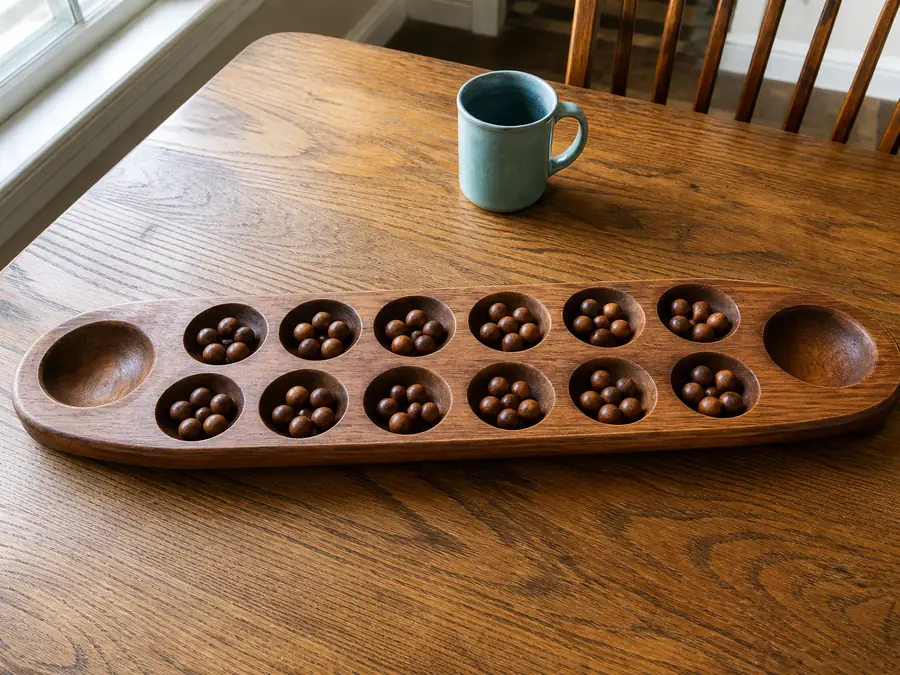
Twelve houses form a loop, six on each side. Every house starts with four seeds. Score is kept off the board; the side bowls only display it and never receive seeds during sowing. South is the near row and always opens; North is the far row and replies.
In the move list on this site, South’s houses are a–f and North’s are A–F. You do not need to memorize that to play, but it helps when you replay the game.
How sowing works
When you tap a house, you do not choose how many seeds to take: every seed in that house is picked up and sown. Drop them one per house counterclockwise among the twelve houses only. Score bowls never receive a seed while sowing. You cannot stop midway or switch to another house.
The original house is emptied at the start of the sow. If the lap is long enough to come around again, that emptied starting house is skipped. Example: South lifts several seeds from one house and drops them into later houses; after that sow, play passes—there is no second turn.
2–3 captures and grand slams
Captures happen only on the opponent’s row. If the last seed lands in an opponent house and leaves exactly 2 or 3, take that house into your score, then continue backward on their side through consecutive houses that still hold 2 or 3. The chain stops at 1, 4 or more, or when you leave their side.
If that capture would take every seed they still have on the board, it is a void grand slam: you score nothing from the capture, but the sow itself stays legal. Abapa has no extra turn and no Kalah-style opposite-pit capture from an empty house of your own.
Feeding and scoring past 24
When the opponent’s six houses are empty, you must play a move that drops at least one seed onto their side whenever such a move exists. Only if every legal sow stays on your side may you continue without feeding. The first side past 24 in score wins; equal 24s are a draw.
Players may also agree a draw. Online rooms can end by resignation.
How it works on this site
The board blocks illegal taps for you, so empty houses, the other row, and other invalid choices do not spend the turn. Against AI you may sit South or North; use hints when you want a nudge, undo if you want to take back your move and the reply, and replay after the game to review the turning point. Two-player mode shares one device, and online rooms let the host choose South or North first.
If you get stuck mid-game, think in this order: is it my turn, which houses on my row still hold seeds, does this last seed leave 2 or 3 on their side, and do I owe a feed? If you can answer those, you can usually finish the first game without trouble. Once sowing feels familiar, continue with Oware tips.
FAQ
Which side moves first in oware?
South always sows first. Against AI you may sit South or North; if you sit North, the AI sows the opening move.
Do seeds ever drop into the score bowls?
No. In Abapa, sowing only visits houses. The side bowls display off-board score and never receive seeds during a sow.
What exactly counts as a capture?
The last seed must land in an opponent house leaving 2 or 3. Capture that house, then continue backward through consecutive 2s and 3s on their side. If the chain would clear every seed they still have on the board, the grand slam is void and nothing is taken.
When their side is empty, may I keep sowing only on mine?
Not if you still have a move that drops at least one seed onto their side. You must feed whenever such a move exists; only when every legal sow stays on your side may you continue without feeding.
Is Abapa the same as Kalah?
No. This site plays Abapa only: a 12-house loop, sowing among houses only, no extra turn, 2–3 captures on the opponent’s side, void grand slams, and feeding. Other sowing games use different pit counts, directions, or capture rules.
